
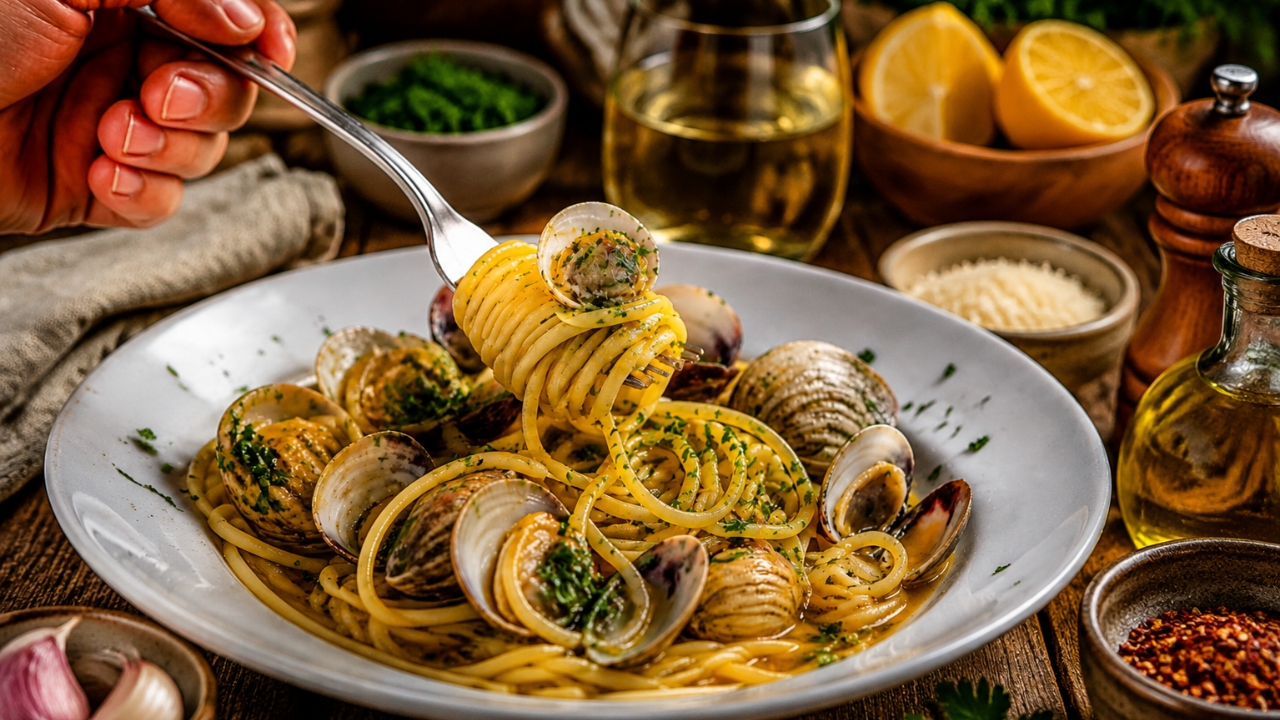
When the first clams of the season arrive on the market stalls, still brimming with life and brine, spaghetti with clams becomes a ritual rather than a simple recipe. It’s not a dish to be improvised: it’s a sensual balance of sea, pasta, and technique, where every gesture must be controlled, almost whispered.
The philosophy of the dish: discipline, not spectacle
Ernst Knam ‘s reinterpretation doesn’t seek special effects, but rather quiet perfection. No unnecessary ingredients, no superfluous concessions: just the freshest clams , delicately handled garlic, elegant extra virgin olive oil, and a cooking technique that transforms the molluscs’ juices into pure gastronomic silk.
Essential information
- Preparation: 20 minutes
- Rest: 2 hours (clam purging)
- Cooking time: 20 minutes
- Servings: 4 people
- Difficulty: Medium
- Style: Classic Italian seafood cuisine, advanced technique
Ingredients
Ingredients for 4 people
- 400 g bronze-drawn durum wheat spaghetti
- 1 kg of very fresh clams with shells
- 4 tablespoons delicate extra virgin olive oil
- 3 cloves of unpeeled new garlic, lightly crushed
- 1 glass of dry white wine (Vermentino or Falanghina)
- 1 fresh chili pepper, seeded
- 1 bunch fresh parsley (stems and leaves separated)
- qb coarse salt for the pasta
- to taste fine salt
- freshly ground black pepper to taste
The perfect technique: step-by-step execution
1. Clam Purging: The Invisible Basis of Success
The clams must be slowly purified in cold salted water (about 35 g per liter). This process, which simulates the sea, allows the mollusks to rid themselves of sand. The water must be changed several times, and the clams must remain alive, responsive, almost vibrant. Any that are open or broken should be discarded immediately: this is where the quality is determined.
 Carlo Cracco svela il segreto della carbonara cremosa senza panna evitando 3 errori davvero comuni
2. Controlled aromas: garlic that seduces without dominating
In a large skillet, heat the oil over medium heat. Add the unpeeled garlic and parsley stalks. The goal isn’t to fry, but to infuse : the oil should be fragrant, smooth, and never overpowering. The chili pepper comes in discreetly, just to spice up the dish without burning it.
 Acqua pazza napoletana di Peppe Guida: la ricetta semplice per un pesce leggero e saporito
3. Opening the clams: steam and precision
Increase the heat and add all the clams at once. Deglaze with white wine and immediately cover. The steam takes over: in a few minutes, the shells open, revealing their glossy, juicy flesh. Ready clams should be removed immediately; the others wait a moment longer. Closed clams remain out of sight.
4. The seabed: liquid gold to be filtered
The resulting liquid is pure marine essence. It must be filtered with extreme care to remove every grain of sand. Some of the clams are shelled, leaving a few whole for an elegant and sensual visual effect in the final dish.
5. Risotto cooking: the transformation of pasta
The spaghetti is cooked only halfway, then transferred to the bottom of the clam shells. This is where the magic begins: the pasta slowly absorbs the liquid, releasing starch and creating a natural, glossy, and enveloping cream. The result is a texture that doesn’t slip, but rather adheres elegantly.
 Frittata di asparagi al forno: la ricetta light con sole 180 calorie perfetta per cena leggera
6. Final stirring: the gesture that signs the dish
Off the heat, add shelled and whole clams, raw olive oil, and chopped fresh parsley. The movement should be firm and circular: a brief dance that emulsifies everything into a velvety, bright, almost seductive sauce. The dish should be served immediately.
The chef’s final secret
Butter isn’t a staple in this recipe: it would mask the natural flavor of the sea. Only a light, fresh extra virgin olive oil, added at the end, can truly capture the dish’s character. Simplicity here isn’t poverty, but conscious luxury.
Ideal match
A minerally, crisp white wine like a Vermentino or Falanghina enhances the clams’ savory flavor without overpowering them. The balance between acidity and sea air completes the experience.

Origin and timeless charm
Born in the alleys of Naples, this dish represents Italian cuisine in its most authentic form: simple in ingredients, yet rich in technique and identity. Knam’s version adds rigor and precision, transforming a popular classic into a refined and contemporary gastronomic experience.